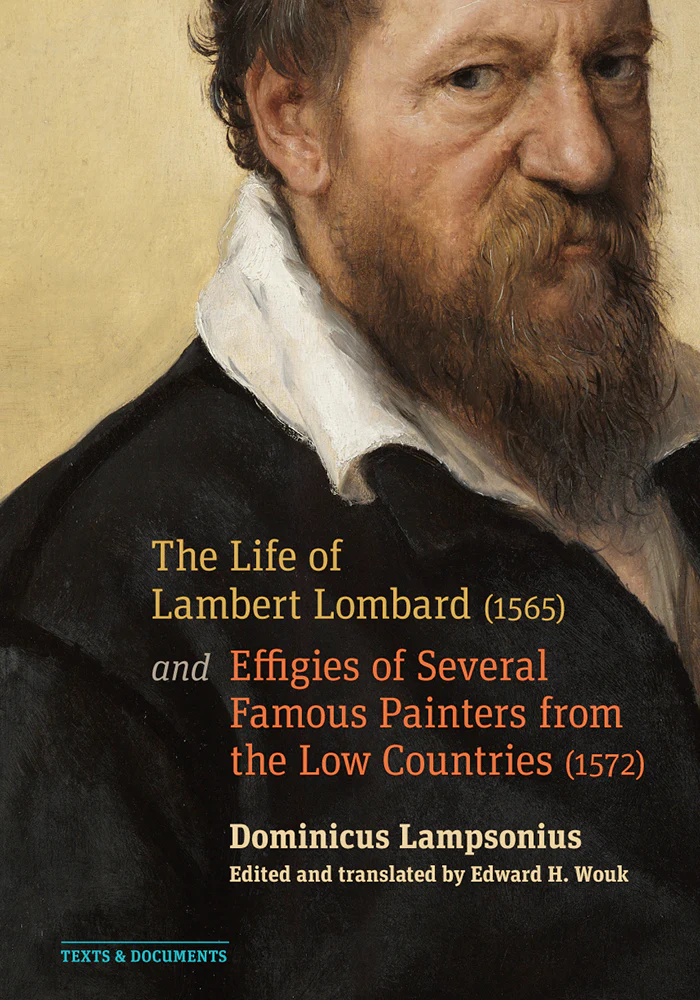
The Life of Lambert Lombard (1565); and Effigies of Several Famous Painters from the Low Countries (1572)
Dominicus Lampsonius
Edited and translated by Edward H. Wouk, with translation assistance by Helen E. B. Dalton and Julene Abad Del Vecchio
Among the earliest written texts on the history and theory of Netherlandish art, these two key writings are now available together in an English translation.
Dominicus Lampsonius’s The Life of Lambert Lombard (1565) is the earliest published biography of a Netherlandish artist. This neo-Latin account of the life of the painter, architect, and draftsman Lambert Lombard of Liège offers a theoretical exposition on the nature and ideal practice of Netherlandish art, emphasizing Lombard’s intellectual curiosity, interest in antiquity, attentive study of the human body, and exemplary generosity as a teacher.
This volume offers the first English edition of The Life of Lambert Lombard, complemented by a new translation of the inscriptions Lampsonius composed to accompany the Effigies of Several Famous Painters from the Low Countries (1572), a cycle of twenty-three engraved portraits of Netherlandish artists developed in collaboration with the print publisher Hieronymus Cock.
Together, The Life of Lambert Lombard and the Effigies established frameworks for a distinctly Netherlandish history of art. Responding to a growing sense of Netherlandish cultural and political identity on the eve of the Dutch Revolt, these texts proposed a critical alternative to Giorgio Vasari’s Lives of the Artists and its Italian model of art historical development, celebrating local ingenuity and skill. They remain the starting point for any history of the northern Renaissance.
Dominicus Lampsonius (1532–1599) was a Flemish polymath humanist, poet, and painter, who worked as Latin secretary to a succession of Catholic bishops, including the embattled English Cardinal Reginald Pole. Edward H. Wouk is reader in art history and visual studies (1400–1800) at the University of Manchester and the author of Frans Floris (1519/20–1570): Imagining a Northern Renaissance (2018).
“Wouk’s volume makes us recognize many significant and intriguing aspects of Lampsonius’s writings.”
—Michiko Fukaya, Renaissance Quarterly
“In reading [this text], we achieve an insight into the varieties and complexities of the art found in Italy and the Low Countries during the sixteenth century.”
—Ethan Todd Krenzer, Comitatus: A Journal of Medieval and Renaissance Studies
“If all of the ideas described here seem diffuse, even daunting, that is because they are. . . . Wouk handles these complexities with such confident concision that readers will oscillate between feeling reassured and compelled to read some passages again. . . . One hopes for a more extensive publication from Wouk, wherein Lombard’s painted oeuvre can receive sharper focus.”
—Arthur J. DiFuria, Historians of Netherlandish Art
“With exemplary clarity and critical acumen, Edward Wouk, Helen E. B. Dalton, and Julene Abad Del Vecchio’s superb translation of two crucial texts on art by Dominicus Lampsonius, humanist man of letters and painter, demonstrates how this important art theoretician promulgated an alternative historiography of art, and specifically, an alternative to Vasari’s Vite, viewing northern workshop practice through the lens of Latin rhetorical and poetic sources, both ancient and modern. This edition of Lampsonius’s The Life of Lambert Lombard and Effigies of Several Famous Painters from the Low Countries will prove as canonical as the source texts it now makes widely accessible.”
—Walter S. Melion, Asa Griggs Candler Professor of Art History, Emory University
“Readers of this superb volume, which provides an introduction to Dominicus Lampsonius and English translations of two of his theoretical texts, will benefit from Edward Wouk’s remarkable erudition, clarity, and insights into European art. Presenting debates about the stakes that gave rise to Lampsonius’s publications, Wouk weaves together encounters, collaborations, and connections drawn from letters, texts, stories, language, and the graphic arts. This nuanced retelling of artistic engagement with antiquity, local traditions, and practices on both sides of the Alps creates a dynamic picture of trans-European exchanges, processes of translation, and Netherlandish inventiveness.”
—Bronwen Wilson, Professor of Renaissance and Early Modern Art, UCLA
“Begun as a long-distance conversation with Vasari, whose Lives of the Artists established the modern historiography of art with Italy as its origin and center, Dominicus Lampsonius’s writings offer a vital alternative: a decentering counter-history of artistic ideas, practices, techniques and developments flourishing north of the Alps. Edward Wouk’s clear and copiously annotated translations of Lampsonius's elusive texts will greatly expand our understanding of the European tradition.”
—Joseph Leo Koerner, Harvard University
“In this book, Edward Wouk generously makes available in English translation two foundational works in the literature of Netherlandish art. Beyond this, he provides a meticulously documented and rigorously argued introduction that significantly advances the revolution in the understanding of elite art in the sixteenth-century Netherlands that has taken place since the publication of Walter Melion’s Picturing the Netherlandish Canon in 1991. The book really is essential reading for everyone seriously interested in this topic.”
—Joanna Woodall, The Courtauld Institute of Art
7 x 10 inches
18 color and 64 b/w illustrations
ISBN 978-1-60606-740-6
paperback
Getty Publications
Imprint: Getty Research Institute
Series: Texts & Documents
2021
Dominicus Lampsonius
Edited and translated by Edward H. Wouk, with translation assistance by Helen E. B. Dalton and Julene Abad Del Vecchio
Among the earliest written texts on the history and theory of Netherlandish art, these two key writings are now available together in an English translation.
Dominicus Lampsonius’s The Life of Lambert Lombard (1565) is the earliest published biography of a Netherlandish artist. This neo-Latin account of the life of the painter, architect, and draftsman Lambert Lombard of Liège offers a theoretical exposition on the nature and ideal practice of Netherlandish art, emphasizing Lombard’s intellectual curiosity, interest in antiquity, attentive study of the human body, and exemplary generosity as a teacher.
This volume offers the first English edition of The Life of Lambert Lombard, complemented by a new translation of the inscriptions Lampsonius composed to accompany the Effigies of Several Famous Painters from the Low Countries (1572), a cycle of twenty-three engraved portraits of Netherlandish artists developed in collaboration with the print publisher Hieronymus Cock.
Together, The Life of Lambert Lombard and the Effigies established frameworks for a distinctly Netherlandish history of art. Responding to a growing sense of Netherlandish cultural and political identity on the eve of the Dutch Revolt, these texts proposed a critical alternative to Giorgio Vasari’s Lives of the Artists and its Italian model of art historical development, celebrating local ingenuity and skill. They remain the starting point for any history of the northern Renaissance.
Dominicus Lampsonius (1532–1599) was a Flemish polymath humanist, poet, and painter, who worked as Latin secretary to a succession of Catholic bishops, including the embattled English Cardinal Reginald Pole. Edward H. Wouk is reader in art history and visual studies (1400–1800) at the University of Manchester and the author of Frans Floris (1519/20–1570): Imagining a Northern Renaissance (2018).
“Wouk’s volume makes us recognize many significant and intriguing aspects of Lampsonius’s writings.”
—Michiko Fukaya, Renaissance Quarterly
“In reading [this text], we achieve an insight into the varieties and complexities of the art found in Italy and the Low Countries during the sixteenth century.”
—Ethan Todd Krenzer, Comitatus: A Journal of Medieval and Renaissance Studies
“If all of the ideas described here seem diffuse, even daunting, that is because they are. . . . Wouk handles these complexities with such confident concision that readers will oscillate between feeling reassured and compelled to read some passages again. . . . One hopes for a more extensive publication from Wouk, wherein Lombard’s painted oeuvre can receive sharper focus.”
—Arthur J. DiFuria, Historians of Netherlandish Art
“With exemplary clarity and critical acumen, Edward Wouk, Helen E. B. Dalton, and Julene Abad Del Vecchio’s superb translation of two crucial texts on art by Dominicus Lampsonius, humanist man of letters and painter, demonstrates how this important art theoretician promulgated an alternative historiography of art, and specifically, an alternative to Vasari’s Vite, viewing northern workshop practice through the lens of Latin rhetorical and poetic sources, both ancient and modern. This edition of Lampsonius’s The Life of Lambert Lombard and Effigies of Several Famous Painters from the Low Countries will prove as canonical as the source texts it now makes widely accessible.”
—Walter S. Melion, Asa Griggs Candler Professor of Art History, Emory University
“Readers of this superb volume, which provides an introduction to Dominicus Lampsonius and English translations of two of his theoretical texts, will benefit from Edward Wouk’s remarkable erudition, clarity, and insights into European art. Presenting debates about the stakes that gave rise to Lampsonius’s publications, Wouk weaves together encounters, collaborations, and connections drawn from letters, texts, stories, language, and the graphic arts. This nuanced retelling of artistic engagement with antiquity, local traditions, and practices on both sides of the Alps creates a dynamic picture of trans-European exchanges, processes of translation, and Netherlandish inventiveness.”
—Bronwen Wilson, Professor of Renaissance and Early Modern Art, UCLA
“Begun as a long-distance conversation with Vasari, whose Lives of the Artists established the modern historiography of art with Italy as its origin and center, Dominicus Lampsonius’s writings offer a vital alternative: a decentering counter-history of artistic ideas, practices, techniques and developments flourishing north of the Alps. Edward Wouk’s clear and copiously annotated translations of Lampsonius's elusive texts will greatly expand our understanding of the European tradition.”
—Joseph Leo Koerner, Harvard University
“In this book, Edward Wouk generously makes available in English translation two foundational works in the literature of Netherlandish art. Beyond this, he provides a meticulously documented and rigorously argued introduction that significantly advances the revolution in the understanding of elite art in the sixteenth-century Netherlands that has taken place since the publication of Walter Melion’s Picturing the Netherlandish Canon in 1991. The book really is essential reading for everyone seriously interested in this topic.”
—Joanna Woodall, The Courtauld Institute of Art
7 x 10 inches
18 color and 64 b/w illustrations
ISBN 978-1-60606-740-6
paperback
Getty Publications
Imprint: Getty Research Institute
Series: Texts & Documents
2021
Original: $60.00
-70%$60.00
$18.00Description
Dominicus Lampsonius
Edited and translated by Edward H. Wouk, with translation assistance by Helen E. B. Dalton and Julene Abad Del Vecchio
Among the earliest written texts on the history and theory of Netherlandish art, these two key writings are now available together in an English translation.
Dominicus Lampsonius’s The Life of Lambert Lombard (1565) is the earliest published biography of a Netherlandish artist. This neo-Latin account of the life of the painter, architect, and draftsman Lambert Lombard of Liège offers a theoretical exposition on the nature and ideal practice of Netherlandish art, emphasizing Lombard’s intellectual curiosity, interest in antiquity, attentive study of the human body, and exemplary generosity as a teacher.
This volume offers the first English edition of The Life of Lambert Lombard, complemented by a new translation of the inscriptions Lampsonius composed to accompany the Effigies of Several Famous Painters from the Low Countries (1572), a cycle of twenty-three engraved portraits of Netherlandish artists developed in collaboration with the print publisher Hieronymus Cock.
Together, The Life of Lambert Lombard and the Effigies established frameworks for a distinctly Netherlandish history of art. Responding to a growing sense of Netherlandish cultural and political identity on the eve of the Dutch Revolt, these texts proposed a critical alternative to Giorgio Vasari’s Lives of the Artists and its Italian model of art historical development, celebrating local ingenuity and skill. They remain the starting point for any history of the northern Renaissance.
Dominicus Lampsonius (1532–1599) was a Flemish polymath humanist, poet, and painter, who worked as Latin secretary to a succession of Catholic bishops, including the embattled English Cardinal Reginald Pole. Edward H. Wouk is reader in art history and visual studies (1400–1800) at the University of Manchester and the author of Frans Floris (1519/20–1570): Imagining a Northern Renaissance (2018).
“Wouk’s volume makes us recognize many significant and intriguing aspects of Lampsonius’s writings.”
—Michiko Fukaya, Renaissance Quarterly
“In reading [this text], we achieve an insight into the varieties and complexities of the art found in Italy and the Low Countries during the sixteenth century.”
—Ethan Todd Krenzer, Comitatus: A Journal of Medieval and Renaissance Studies
“If all of the ideas described here seem diffuse, even daunting, that is because they are. . . . Wouk handles these complexities with such confident concision that readers will oscillate between feeling reassured and compelled to read some passages again. . . . One hopes for a more extensive publication from Wouk, wherein Lombard’s painted oeuvre can receive sharper focus.”
—Arthur J. DiFuria, Historians of Netherlandish Art
“With exemplary clarity and critical acumen, Edward Wouk, Helen E. B. Dalton, and Julene Abad Del Vecchio’s superb translation of two crucial texts on art by Dominicus Lampsonius, humanist man of letters and painter, demonstrates how this important art theoretician promulgated an alternative historiography of art, and specifically, an alternative to Vasari’s Vite, viewing northern workshop practice through the lens of Latin rhetorical and poetic sources, both ancient and modern. This edition of Lampsonius’s The Life of Lambert Lombard and Effigies of Several Famous Painters from the Low Countries will prove as canonical as the source texts it now makes widely accessible.”
—Walter S. Melion, Asa Griggs Candler Professor of Art History, Emory University
“Readers of this superb volume, which provides an introduction to Dominicus Lampsonius and English translations of two of his theoretical texts, will benefit from Edward Wouk’s remarkable erudition, clarity, and insights into European art. Presenting debates about the stakes that gave rise to Lampsonius’s publications, Wouk weaves together encounters, collaborations, and connections drawn from letters, texts, stories, language, and the graphic arts. This nuanced retelling of artistic engagement with antiquity, local traditions, and practices on both sides of the Alps creates a dynamic picture of trans-European exchanges, processes of translation, and Netherlandish inventiveness.”
—Bronwen Wilson, Professor of Renaissance and Early Modern Art, UCLA
“Begun as a long-distance conversation with Vasari, whose Lives of the Artists established the modern historiography of art with Italy as its origin and center, Dominicus Lampsonius’s writings offer a vital alternative: a decentering counter-history of artistic ideas, practices, techniques and developments flourishing north of the Alps. Edward Wouk’s clear and copiously annotated translations of Lampsonius's elusive texts will greatly expand our understanding of the European tradition.”
—Joseph Leo Koerner, Harvard University
“In this book, Edward Wouk generously makes available in English translation two foundational works in the literature of Netherlandish art. Beyond this, he provides a meticulously documented and rigorously argued introduction that significantly advances the revolution in the understanding of elite art in the sixteenth-century Netherlands that has taken place since the publication of Walter Melion’s Picturing the Netherlandish Canon in 1991. The book really is essential reading for everyone seriously interested in this topic.”
—Joanna Woodall, The Courtauld Institute of Art
7 x 10 inches
18 color and 64 b/w illustrations
ISBN 978-1-60606-740-6
paperback
Getty Publications
Imprint: Getty Research Institute
Series: Texts & Documents
2021