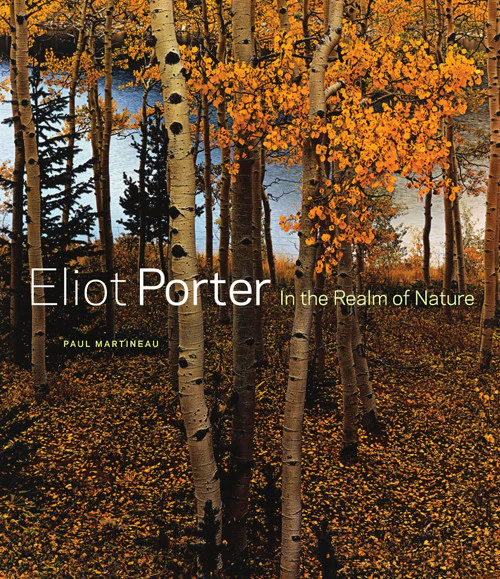
Eliot Porter: In the Realm of Nature
Paul Martineau
With a foreword by Michael Brune
Known for his exquisite images of birds and landscape, Eliot Porter (American, 1901–1990) was a pioneer in the use of color photography. His work also became a powerful visual argument for environmental conservation. Trained as a medical doctor and possessing a scientist’s gift for close observation, Porter explored new ways of depicting nature, building blinds in trees so he could study his avian subjects at closer vantage and producing landscape images that capture both pristine forest and ragged river canyons with equal force and brilliance.
Initially encouraged by the groundbreaking photographers Ansel Adams and Alfred Stieglitz, Porter went on to produce a body of work all his own. His 1962 Sierra Club book In Wildness Is the Preservation of the World, with its images grouped by season and accompanied by quotations from Henry David Thoreau, transformed the concept of nature photography books. Ultimately, Porter’s photographs came to the attention of Congress and led to the passage of the Wilderness Act of 1964, the foundational law in wilderness management today.
Eliot Porter: In the Realm of Nature contains 110 images from the collections of Daniel Greenberg and Susan Steinhauser at the Amon Carter Museum, Fort Worth, Texas, and of the J. Paul Getty Museum, along with an essay by Paul Martineau that discusses Porter’s life and the innovations he brought to the practice of photography.
Paul Martineau is an associate curator in the Department of Photographs at the J. Paul Getty Museum and author of Herb Ritts: L.A. Style (Getty Publications, 2012) and Paul Outerbridge: Command Performance (Getty Publications, 2009). Michael Brune is executive director of the Sierra Club.
“For the last several decades landscape photographers have concentrated on showing man’s depredations of nature, but their pictures only take on meaning when set against images of untrammeled beauty by artists such as Eliot Porter.”
—Wall Street Journal
“Arranged thematically, each photograph in this very fine book evolves to the next, so that the reader has a true sense of the artist’s preoccupations.”
—Publishers Weekly
“Some of Eliot Porter’s loveliest photographs of birds and fragments of the natural landscape make up this handsome sampling of his work. . . . His subjects are so subtle as to be almost invisible to a casual observer. But once Porter shows them to us, we cannot stop looking.”
—ARTnews
“Gorgeous.”
—Christianity Today
“Beautiful. . . . A concise course in what may be done with a camera in the hands of a master.”
—Choice
“An absolutely exquisite collection.”
—Shelf Awareness
“Eliot Porter . . . was one of the pioneers in the use of color photography, and the pioneer in portraying birds and other elements of the natural scene in color.”
—Pasatiempo
“The photo reproductions are, in a word, superb. […] If you own only one Eliot Porter book, this is the one to have.”
—Online Photographer
144 pages
9 1/2 x11 inches
80 color and 30 b/w illustrations
ISBN 978-1-60606-119-0
hardcover
Getty Publications
Imprint: J. Paul Getty Museum
2012
Paul Martineau
With a foreword by Michael Brune
Known for his exquisite images of birds and landscape, Eliot Porter (American, 1901–1990) was a pioneer in the use of color photography. His work also became a powerful visual argument for environmental conservation. Trained as a medical doctor and possessing a scientist’s gift for close observation, Porter explored new ways of depicting nature, building blinds in trees so he could study his avian subjects at closer vantage and producing landscape images that capture both pristine forest and ragged river canyons with equal force and brilliance.
Initially encouraged by the groundbreaking photographers Ansel Adams and Alfred Stieglitz, Porter went on to produce a body of work all his own. His 1962 Sierra Club book In Wildness Is the Preservation of the World, with its images grouped by season and accompanied by quotations from Henry David Thoreau, transformed the concept of nature photography books. Ultimately, Porter’s photographs came to the attention of Congress and led to the passage of the Wilderness Act of 1964, the foundational law in wilderness management today.
Eliot Porter: In the Realm of Nature contains 110 images from the collections of Daniel Greenberg and Susan Steinhauser at the Amon Carter Museum, Fort Worth, Texas, and of the J. Paul Getty Museum, along with an essay by Paul Martineau that discusses Porter’s life and the innovations he brought to the practice of photography.
Paul Martineau is an associate curator in the Department of Photographs at the J. Paul Getty Museum and author of Herb Ritts: L.A. Style (Getty Publications, 2012) and Paul Outerbridge: Command Performance (Getty Publications, 2009). Michael Brune is executive director of the Sierra Club.
“For the last several decades landscape photographers have concentrated on showing man’s depredations of nature, but their pictures only take on meaning when set against images of untrammeled beauty by artists such as Eliot Porter.”
—Wall Street Journal
“Arranged thematically, each photograph in this very fine book evolves to the next, so that the reader has a true sense of the artist’s preoccupations.”
—Publishers Weekly
“Some of Eliot Porter’s loveliest photographs of birds and fragments of the natural landscape make up this handsome sampling of his work. . . . His subjects are so subtle as to be almost invisible to a casual observer. But once Porter shows them to us, we cannot stop looking.”
—ARTnews
“Gorgeous.”
—Christianity Today
“Beautiful. . . . A concise course in what may be done with a camera in the hands of a master.”
—Choice
“An absolutely exquisite collection.”
—Shelf Awareness
“Eliot Porter . . . was one of the pioneers in the use of color photography, and the pioneer in portraying birds and other elements of the natural scene in color.”
—Pasatiempo
“The photo reproductions are, in a word, superb. […] If you own only one Eliot Porter book, this is the one to have.”
—Online Photographer
144 pages
9 1/2 x11 inches
80 color and 30 b/w illustrations
ISBN 978-1-60606-119-0
hardcover
Getty Publications
Imprint: J. Paul Getty Museum
2012
Original: $39.95
-70%$39.95
$11.99Description
Paul Martineau
With a foreword by Michael Brune
Known for his exquisite images of birds and landscape, Eliot Porter (American, 1901–1990) was a pioneer in the use of color photography. His work also became a powerful visual argument for environmental conservation. Trained as a medical doctor and possessing a scientist’s gift for close observation, Porter explored new ways of depicting nature, building blinds in trees so he could study his avian subjects at closer vantage and producing landscape images that capture both pristine forest and ragged river canyons with equal force and brilliance.
Initially encouraged by the groundbreaking photographers Ansel Adams and Alfred Stieglitz, Porter went on to produce a body of work all his own. His 1962 Sierra Club book In Wildness Is the Preservation of the World, with its images grouped by season and accompanied by quotations from Henry David Thoreau, transformed the concept of nature photography books. Ultimately, Porter’s photographs came to the attention of Congress and led to the passage of the Wilderness Act of 1964, the foundational law in wilderness management today.
Eliot Porter: In the Realm of Nature contains 110 images from the collections of Daniel Greenberg and Susan Steinhauser at the Amon Carter Museum, Fort Worth, Texas, and of the J. Paul Getty Museum, along with an essay by Paul Martineau that discusses Porter’s life and the innovations he brought to the practice of photography.
Paul Martineau is an associate curator in the Department of Photographs at the J. Paul Getty Museum and author of Herb Ritts: L.A. Style (Getty Publications, 2012) and Paul Outerbridge: Command Performance (Getty Publications, 2009). Michael Brune is executive director of the Sierra Club.
“For the last several decades landscape photographers have concentrated on showing man’s depredations of nature, but their pictures only take on meaning when set against images of untrammeled beauty by artists such as Eliot Porter.”
—Wall Street Journal
“Arranged thematically, each photograph in this very fine book evolves to the next, so that the reader has a true sense of the artist’s preoccupations.”
—Publishers Weekly
“Some of Eliot Porter’s loveliest photographs of birds and fragments of the natural landscape make up this handsome sampling of his work. . . . His subjects are so subtle as to be almost invisible to a casual observer. But once Porter shows them to us, we cannot stop looking.”
—ARTnews
“Gorgeous.”
—Christianity Today
“Beautiful. . . . A concise course in what may be done with a camera in the hands of a master.”
—Choice
“An absolutely exquisite collection.”
—Shelf Awareness
“Eliot Porter . . . was one of the pioneers in the use of color photography, and the pioneer in portraying birds and other elements of the natural scene in color.”
—Pasatiempo
“The photo reproductions are, in a word, superb. […] If you own only one Eliot Porter book, this is the one to have.”
—Online Photographer
144 pages
9 1/2 x11 inches
80 color and 30 b/w illustrations
ISBN 978-1-60606-119-0
hardcover
Getty Publications
Imprint: J. Paul Getty Museum
2012