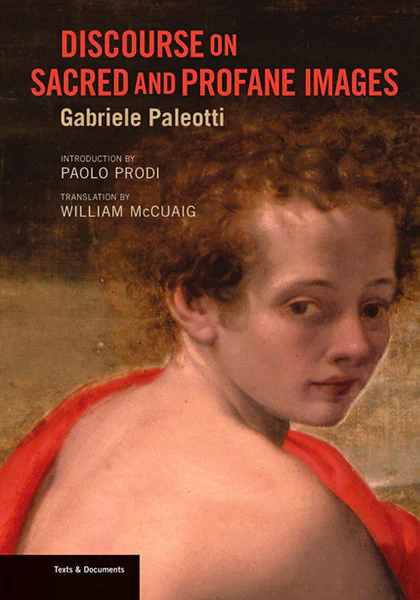
Discourse on Sacred and Profane Images
Gabriele Paleotti
Introduction by Paolo Prodi
Translated by William McCuaig
In the wake of the Counter-Reformation, Cardinal Gabriele Paleotti, the archbishop of Bologna, wrote a remarkable treatise on art during a time when the Church feared rampant abuse in the arts. Translated into English here for the first time, Paleotti’s Discourse on Sacred and Profane Images argues that art should address a broad audience and explains the painter’s responsibility to his spectators. The Discourse is introduced by historian Paolo Prodi, who explains how—even if the archbishop did not succeed in reforming the arts—Paleotti’s treatise constituted one last synthesis of art as a reading of creation and salvation history, and “sacred” art as a vehicle of devotion.
Gabriele Paleotti (1522–1597) was an Italian cardinal and archbishop of Bologna. Paolo Prodi is professor emeritus of modern history at the Università di Bologna, a member of the Accademia dei Lincei of Rome, and president of the Italian Giunta Storica Nazionale. William McCuaig is a translator living in Montreal and the author of Carlo Sigonio: The Changing World of the Late Renaissance (Princeton University Press, 1989).
“Important.”
—Art Newspaper
“[This book] will be an asset not only to scholars but to lay readers in the field of art history.”
—Steve Goddard’s History Wire
368 pages
7 x 10 inches
11 b/w illustrations
ISBN 978-1-60606-116-9
paperback
Getty Publications
Imprint: Getty Research Institute
Series: Texts & Documents
2012
Gabriele Paleotti
Introduction by Paolo Prodi
Translated by William McCuaig
In the wake of the Counter-Reformation, Cardinal Gabriele Paleotti, the archbishop of Bologna, wrote a remarkable treatise on art during a time when the Church feared rampant abuse in the arts. Translated into English here for the first time, Paleotti’s Discourse on Sacred and Profane Images argues that art should address a broad audience and explains the painter’s responsibility to his spectators. The Discourse is introduced by historian Paolo Prodi, who explains how—even if the archbishop did not succeed in reforming the arts—Paleotti’s treatise constituted one last synthesis of art as a reading of creation and salvation history, and “sacred” art as a vehicle of devotion.
Gabriele Paleotti (1522–1597) was an Italian cardinal and archbishop of Bologna. Paolo Prodi is professor emeritus of modern history at the Università di Bologna, a member of the Accademia dei Lincei of Rome, and president of the Italian Giunta Storica Nazionale. William McCuaig is a translator living in Montreal and the author of Carlo Sigonio: The Changing World of the Late Renaissance (Princeton University Press, 1989).
“Important.”
—Art Newspaper
“[This book] will be an asset not only to scholars but to lay readers in the field of art history.”
—Steve Goddard’s History Wire
368 pages
7 x 10 inches
11 b/w illustrations
ISBN 978-1-60606-116-9
paperback
Getty Publications
Imprint: Getty Research Institute
Series: Texts & Documents
2012
Original: $60.00
-70%$60.00
$18.00Description
Gabriele Paleotti
Introduction by Paolo Prodi
Translated by William McCuaig
In the wake of the Counter-Reformation, Cardinal Gabriele Paleotti, the archbishop of Bologna, wrote a remarkable treatise on art during a time when the Church feared rampant abuse in the arts. Translated into English here for the first time, Paleotti’s Discourse on Sacred and Profane Images argues that art should address a broad audience and explains the painter’s responsibility to his spectators. The Discourse is introduced by historian Paolo Prodi, who explains how—even if the archbishop did not succeed in reforming the arts—Paleotti’s treatise constituted one last synthesis of art as a reading of creation and salvation history, and “sacred” art as a vehicle of devotion.
Gabriele Paleotti (1522–1597) was an Italian cardinal and archbishop of Bologna. Paolo Prodi is professor emeritus of modern history at the Università di Bologna, a member of the Accademia dei Lincei of Rome, and president of the Italian Giunta Storica Nazionale. William McCuaig is a translator living in Montreal and the author of Carlo Sigonio: The Changing World of the Late Renaissance (Princeton University Press, 1989).
“Important.”
—Art Newspaper
“[This book] will be an asset not only to scholars but to lay readers in the field of art history.”
—Steve Goddard’s History Wire
368 pages
7 x 10 inches
11 b/w illustrations
ISBN 978-1-60606-116-9
paperback
Getty Publications
Imprint: Getty Research Institute
Series: Texts & Documents
2012